
Compact connection for small-bore piping
Product formFlanges
/ 01 — TECHNICAL OVERVIEW
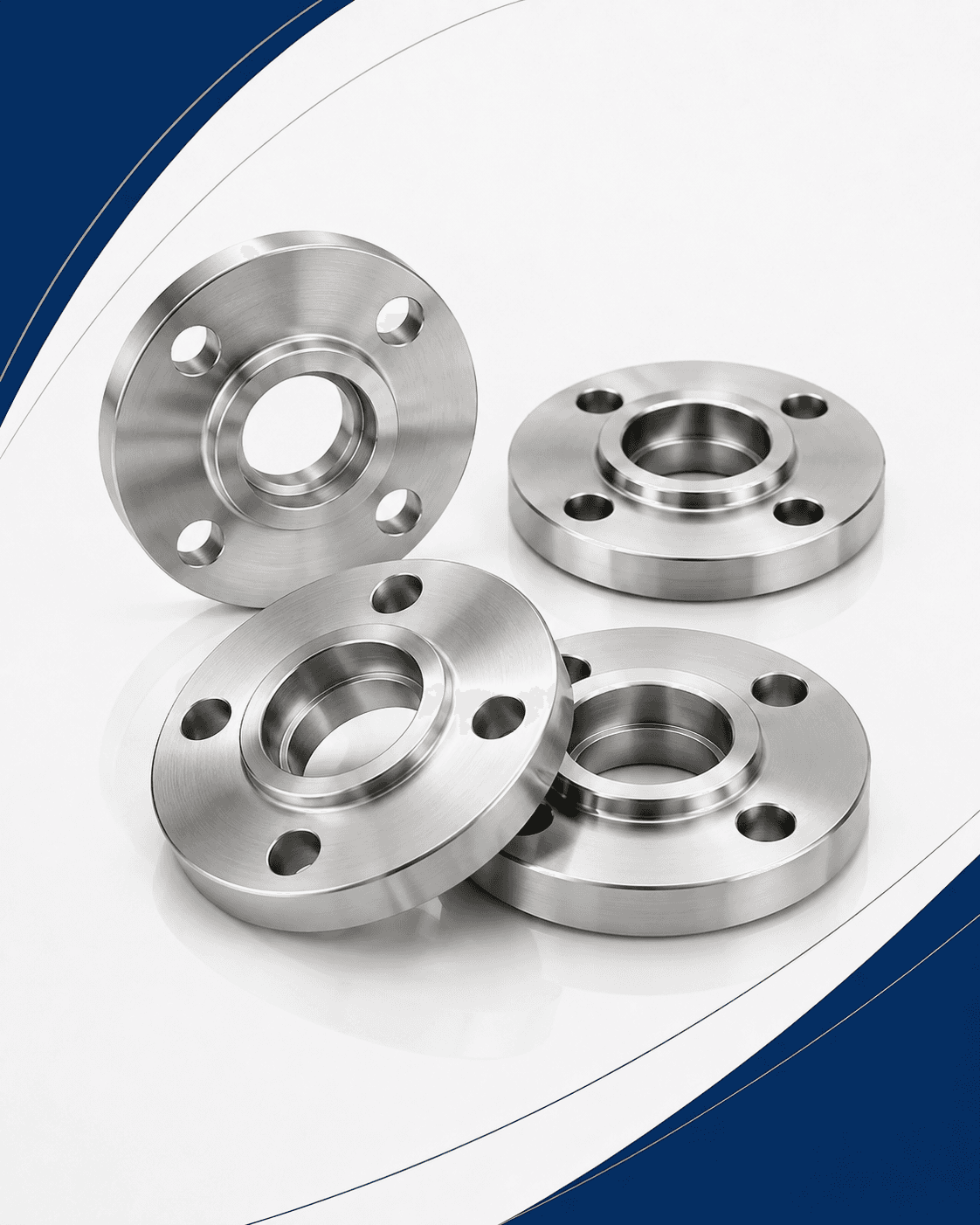
Socket Weld Flanges
Flanges create detachable, bolted connections between pipe, valves, vessels and equipment. Correct selection requires the material grade, standard, nominal size, pressure class, facing, bore, wall schedule, dimensions and testing requirements to be defined together.
Whether the requirement is for standard maintenance quantities or a project package, our team reviews each flange requirement against the requested material, dimensions, specification, service conditions, inspection and delivery plan. Availability may include ex-stock, mill production or made-to-order supply depending on the combination.
NESCO Pipe & Tubes supplies and exports industrial flanges for piping, process, pressure equipment and engineering applications. Our flange range includes Weld Neck, Slip-On, Blind, Socket Weld and Threaded flanges in stainless steel, duplex, super duplex, nickel alloys, titanium and other applicable materials.
Flanges can be supplied in accordance with applicable ASME, ASTM, EN and project-specific requirements, with different pressure classes, sizes, facings, bore configurations and machining requirements available subject to specification and availability.
NESCO supports standard and project-specific requirements with material traceability, Mill Test Certificates, inspection coordination and export-ready packing as required.
Other flange configurations available on request include Lap Joint, Orifice and project-specific flanges.
How it is made
01
Forged raw material is heat treated to the applicable piping material specification.
02
The bore and internal socket are machined to support accurate small-bore pipe fit-up.
03
Facing, hub, thickness and bolt-hole dimensions are completed to the ordered class.
04
Socket depth, bore transition and gasket finish are verified dimensionally.
05
PMI, visual inspection, marking and documentation are completed before packing.
Request reviewed quotation Material documents on request
/ 02 — PRODUCT DETAIL
Built around the specification.
Socket weld flanges contain a recessed socket into which the pipe is inserted before fillet welding. They are commonly used on small-bore, high-pressure piping where compact connections are desired.
Key features01 02 03 04
Good alignment during installation
Common in high-pressure utility and process services
Requires specified expansion gap and qualified welding practice
Common specification references
STD
ASME B16.5
STD
ASME B16.11 relevance for associated socket-weld fittings
STD
Material specification per piping class
Explore the flanges range
/ 03 — AVAILABLE GRADES
Available Material Grades
NESCO supplies the material families shown below in flange form, subject to flange type, grade, size, pressure class, facing, bore and availability.
Material familyCommon gradesTypical selection context
Stainless steelASTM A182 F304, F304L, F316, F316L, F321, F347, F347H and F904L (UNS N08904)
General pressure piping, process and elevated-temperature service
Duplex stainless steelASTM A182 F51 (UNS S31803) and F60 (UNS S32205 / 2205)
Higher-strength and chloride-bearing service
Super duplex stainless steelASTM A182 F53 (UNS S32750 / 2507) and F55 (UNS S32760)
High-strength seawater and severe chloride service
Nickel alloysASTM B564 UNS N04400, N06600, N06625, N08825 and N10276
Severe corrosion and elevated-temperature duties
TitaniumASTM B381 Grade 2 and Grade 5
Seawater and selected chemical systems
Copper-nickelUNS C70600 (Cu-Ni 90/10) and UNS C71500 (Cu-Ni 70/30)
Marine, condenser and seawater systems
/ 04 — SUPPLY & CUSTOMISATION
Define the supply condition.
Final availability depends on the complete combination of material, dimensions, standard, condition, testing and quantity.
ParameterTypical information to specify
01Standards
ASME B16.5, ASME B16.47 or project drawings
02Sizes
NPS and bore/schedule as specified
03Pressure classes
Class 150, 300, 600, 900, 1500 and 2500 where applicable
04Facings
RF, FF, RTJ and special facings
05Finish
Serrated or smooth facing finish as specified
06Marking
Grade, heat number, size, class, standard and manufacturer identification
07Testing
PMI, hardness, UT, dimensional and other approved inspections
/ 05 — DIMENSIONS & SIZE RANGE
Dimensions aligned to the manufacturing route.
Flange size alone is insufficient. The dimensional standard, pressure class or PN, facing and bore must be specified together.
Design inputTypical optionsRequired RFQ detailWhy it matters
Nominal sizeNPS / DNMatching pipe or nozzle sizeControls flange envelope and drilling
RatingClass 150-2500 or applicable PNStandard plus class / PNControls pressure-temperature basis
FacingRF, FF, RTJ or specialFacing and finishMust match gasket and mating flange
BoreStandard bore or pipe-schedule boreMatching wall / scheduleSupports alignment and weld transition
/ 06 — MANUFACTURING STANDARDS
Standards aligned for every order.
The material standard, dimensional standard and project requirements should be stated separately.
ReferenceWhat it coversRole
ASME B16.5Pipe flanges and flanged fittings, generally NPS 1/2 through NPS 24
Dimensions / ratings
ASME B16.47Large-diameter steel flanges
Large-bore dimensions
ASTM A182/A182MForged or rolled alloy and stainless piping components
Material specification
ASTM B564 / ASTM B381Material specifications for nickel-alloy and titanium forgings, respectively, as applicable to the supplied product
Special-alloy material
EN 1092-1Circular steel flanges under European PN designation
European dimensions
Project drawingNon-standard bore, facing, drilling and tolerance
Custom requirement
/ FLANGE SELECTION GUIDE
Choose the flange around the joint and service.
Use the connection method, pressure-temperature duty, piping class and maintenance needs as the starting point. The approved piping specification governs final selection.
Flange typeTypical use
Weld NeckHigh-pressure, high-temperature and critical service
Slip-OnGeneral, utility and process piping where economical installation is suitable
BlindClosing pipe ends, nozzles and future connections
Socket WeldSmall-bore pressure piping
ThreadedSelected services where welding is restricted
Lap JointSystems requiring frequent dismantling or alignment flexibility
OrificeFlow measurement assemblies
/ 07 — INSPECTION & TESTING
Evidence before dispatch.
01MTC and forging heat traceability
02NPS, class, OD, thickness and bolt-circle checks
03Bore and hub dimensions
04Facing type and surface-finish verification
05PMI and hardness when specified
06UT or liquid-penetrant examination where ordered
07Marking and face-protection verification
08Testing and inspection arranged to the purchase order, approved ITP or project requirements
PACKAGING & MARKING
Protected and traceable.
01Machined faces protected with covers or non-abrasive separators
02Small flanges boxed; larger flanges secured on pallets
03Threads, RTJ grooves and bores protected from impact
04Heat and piece traceability retained after machining
05Export packages labelled with type, grade, NPS, class and PO
/ 08 — APPLICATIONS & INDUSTRIES
Engineered for demanding service environments.
From process plants to marine systems, NESCO coordinates material, dimensions and documentation around the operating conditions of each application.
01
Process piping connections02
Pressure vessels and nozzles03
Valves, pumps and compressors04
Refineries and petrochemical plants05
Power and steam systems06
Marine and water systems07
Chemical processing equipment08
Maintenance and shutdown projectsIndustries servedOne supply partner across critical sectors.
RefineriesPetrochemicalsOil & gasPower generationChemical processingMarineWater & desalinationPressure equipment
/ 09 — WHY NESCO PIPE & TUBES
Built for buyers who cannot leave details to chance.
From specification review to export documentation, NESCO coordinates the technical and commercial details as one complete supply requirement.
01
Specification control
NESCO reviews the grade, product standard, dimensions, condition and acceptance criteria as one coordinated requirement.
02
Multi-material sourcing
Stainless steel, duplex, nickel alloy, copper-nickel and titanium requirements can be combined within one project enquiry.
03
Traceable documentation
Heat numbers, MTCs and agreed inspection records are aligned with the purchase order before dispatch.
04
Inspection coordination
PMI, dimensional checks, NDT and third-party witnessing can be arranged against an approved inspection plan.
05
Value-added processing
Cutting, machining, end preparation, polishing or protective finishing can be reviewed with the base material supply.
06
Export-ready packing
Identification, surface protection and packing are planned around product geometry and the final transport route.
07
Responsive RFQ review
Technical and commercial inputs are consolidated early so queries are resolved before quotation and production.
08
One accountable supply desk
NESCO provides a single contact for material, processing, documentation, packing and delivery coordination.
/ 10 — FREQUENTLY ASKED QUESTIONS
Clear answers before you specify.
Quick guidance on product selection, standards, dimensions, inspection and documentation. For project-specific requirements, NESCO will review the complete enquiry with your team.
01Where are socket weld flanges normally used?
They are commonly used in compact small-bore pressure piping, subject to the project piping class and service restrictions.
02Why is an insertion gap specified?
The approved welding procedure may require a gap between the pipe end and socket shoulder to manage weld shrinkage and stress.
03Which flange details are essential for quotation?
State type, material grade, dimensional standard, NPS, pressure class, bore or schedule, facing, finish, quantity and inspection.
04What is the difference between Class and PN ratings?
Class and PN belong to different flange standard systems and are not direct dimensional substitutes. Use the complete selected standard and rating.
05Why must facing finish be specified?
Gasket performance depends on facing type, groove geometry and surface finish. The piping specification should define the required gasket seating surface.
06Can custom flanges be manufactured to drawings?
Yes, subject to approved material, design responsibility, machining drawing, tolerances, testing and quantity.
/ 11 — REQUEST FOR QUOTATION Nesco direct sales desk
Ready to source?Start with the details you already have.
Our team will review the grade, dimensions, testing and delivery requirements together.